
Choosing the right bulk bag is not simply about selecting a standard size from a catalog. The dimensions of an FIBC bag need to match the material being packed, the required filling weight, and the available space for storage and transportation.
A bag that is too small may not hold the required quantity of material, while an oversized bag can waste packaging space and make handling less efficient.
For importers, distributors, and manufacturers, understanding how to choose the right bulk bag dimensions is an important step in developing an effective packaging solution.
This guide explains the key factors to consider, how to estimate the required bag volume, and what information to prepare before requesting a quotation from an FIBC supplier.
Start With the Material, Not the Bag Size
Standard bulk bags are Flexible Intermediate Bulk Containers (FIBCs) made from woven polypropylene (PP) fabric. They are designed to package, store, and transport large quantities of dry bulk materials.
Unlike baffled bags, standard bulk bags do not have additional internal corner panels to control outward bulging.
When filled, the fabric walls can expand outward depending on the material, filling weight, bag dimensions, and construction.
Key Features of Standard FIBC Bags:
-
Simple and practical construction.
-
Available in U-panel and circular designs.
-
Suitable for various powders, granules, and agricultural materials.
-
Customizable dimensions and safe working loads.
-
Available with different top and bottom configurations.
Standard bulk bags are a practical choice for many applications where a conventional bag shape is sufficient and maximum space utilization is not the primary concern.
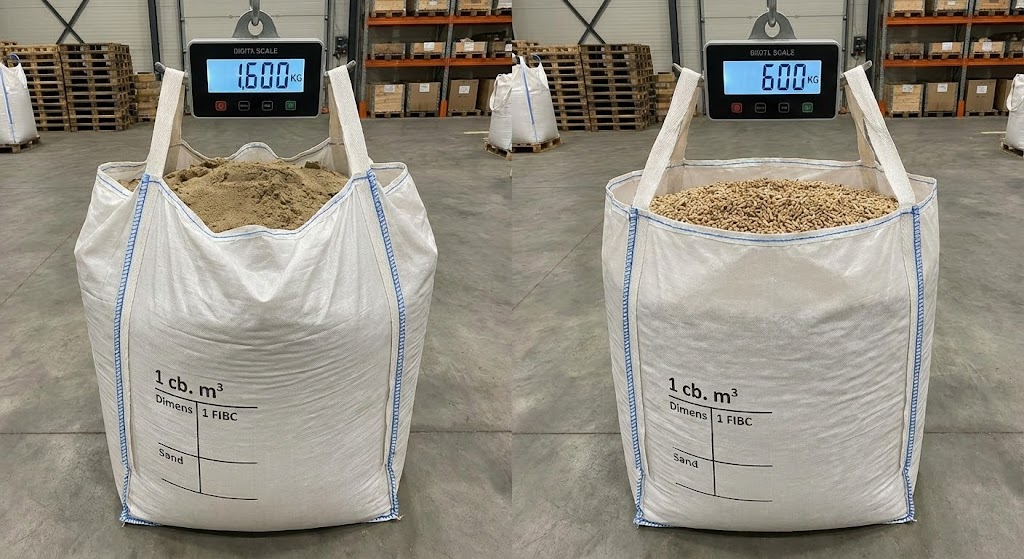
Calculate the Volume You Actually Need
Once the material density and target filling weight are known, you can estimate the required bag volume.
The basic formula is:
Required Volume (m³) = Target Filling Weight (kg) ÷ Bulk Density (kg/m³)
For example, suppose you need to package 1,000 kg of material with a bulk density of 800 kg/m³.
Required volume:
1,000 ÷ 800 = 1.25 m³
This means the material occupies approximately 1.25 cubic meters under the stated density conditions.
However, this calculation is only a starting point. The final FIBC dimensions must also account for the bag construction, filling method, material behavior, and the space needed for the bag to close or operate correctly.
A Simple Volume Reference
| Target Weight | Bulk Density | Estimated Volume |
|---|---|---|
| 500 kg | 500 kg/m³ | 1.00 m³ |
| 500 kg | 1,000 kg/m³ | 0.50 m³ |
| 1,000 kg | 500 kg/m³ | 2.00 m³ |
| 1,000 kg | 800 kg/m³ | 1.25 m³ |
| 1,000 kg | 1,000 kg/m³ | 1.00 m³ |
| 1,500 kg | 1,000 kg/m³ | 1.50 m³ |
The figures above are estimated material volumes, not guaranteed FIBC capacities. Actual bag dimensions should be confirmed with the supplier based on the intended filling and handling conditions.
Turn the Required Volume Into Practical Dimensions
After estimating the volume, the next step is to determine the bag’s length, width, and height.
For a simple rectangular approximation:
Volume (m³) = Length (m) × Width (m) × Height (m)
For example, a nominal rectangular space measuring 90 × 90 × 155 cm has a calculated volume of approximately 1.26 m³.
This is close to the 1.25 m³ estimated in the previous example.
However, an FIBC bag is a flexible container, not a rigid box. Its actual filled shape can change depending on the fabric, seams, filling pressure, material density, and construction.
For this reason, a mathematical volume calculation should never be treated as a final bag-size specification.
When confirming dimensions with your supplier, discuss:
-
Required internal or nominal dimensions.
-
Expected filled dimensions.
-
Filling and discharge equipment.
-
Required headspace and closure arrangement.
-
Whether the bag needs internal baffles.
Match the Bag to Your Warehouse and Shipping Setup
The right dimensions should work not only for the material but also for the entire supply chain.
A bag that holds the correct quantity may still create problems if it does not fit your pallet arrangement, warehouse layout, or container loading plan.
Pallet Compatibility
Check the dimensions of your pallets before confirming the bag size. The filled bag should fit the intended pallet arrangement without excessive overhang or instability.
Warehouse Storage
If your bags are stored in rows or stacked, consider the available floor space, storage height, handling equipment, and applicable stacking safety requirements.
Container Loading
For international shipments, the external dimensions of filled bags matter. Ask your supplier to consider the intended container type and loading method.
Do not calculate container capacity using only the nominal empty-bag dimensions. Filled bag dimensions can differ from the original specifications, particularly when the material causes the bag walls to expand.
Select the Right Construction for Your Required Shape
Bag dimensions and bag construction should be considered together.
Two bags with similar nominal dimensions may have different filled shapes because of their construction.
U-Panel FIBC Bags
U-panel bags use a continuous U-shaped fabric section to form the bottom and two opposite sides. They are a common option for general industrial bulk packaging.
Circular FIBC Bags
Circular bags use tubular woven PP fabric to form the main body. They are another practical option for customers looking for customized bulk packaging.
Baffle FIBC Bags
Baffle bags include internal fabric panels that help control outward bulging and maintain a more square shape after filling.
Both U-panel and circular base constructions can be designed with internal baffles, depending on the required specifications.
If space utilization and consistent filled dimensions are important, discuss baffled construction with your supplier before finalizing the bag dimensions.
For more details, read our guides to U-Panel vs Circular Bulk Bags and Baffle Bags vs Standard Bulk Bags.
Before You Request a Quotation: Prepare These Specifications
To avoid repeated revisions and misunderstandings, prepare the following information before contacting an FIBC manufacturer.
| Specification | Information to Provide |
|---|---|
| Material | Product name and material type |
| Bulk density | Density in kg/m³ |
| Filling weight | Required net weight per bag |
| Bag dimensions | Length × Width × Height |
| Top design | Open top, duffle top, or filling spout |
| Bottom design | Flat bottom or discharge spout |
| Bag construction | U-panel, circular, or baffle |
| Safe Working Load | Required SWL |
| Safety Factor | Required specification, where applicable |
| Additional options | Liner, coating, printing, and other features |
| Handling method | Forklift, lifting equipment, pallet, or other method |
You do not need to finalize every technical detail before making an inquiry. If you provide the material type, bulk density, target filling weight, and intended application, an experienced supplier can help evaluate a suitable design.
Important: The Safe Working Load (SWL) is not determined by bag volume alone. It depends on the complete bag design, including fabric specifications, stitching, lifting loops, construction, and relevant testing.
Make Your Bulk Bag Dimensions Work for Your Business
The best bulk bag dimensions are those that match your material, filling requirements, handling equipment, and shipping conditions.
Instead of choosing a bag size based only on a standard catalog, start with the material density and required filling weight. Then evaluate the volume, bag construction, filled dimensions, and available storage and transportation space.
At UWON Packaging, we provide customized FIBC bulk bags based on customer requirements, including U-panel, circular, and baffle designs.
Whether you are packaging agricultural products, chemicals, minerals, or plastic resins, our team can help you evaluate the appropriate bag dimensions and specifications.
Contact our team today with your material details and target filling weight to discuss a suitable FIBC packaging solution.
Frequently Asked Questions
1. What are standard bulk bag dimensions?
There is no single standard size suitable for every application. FIBC dimensions vary according to material density, filling weight, handling requirements, and customer specifications.
2. How do I calculate the required bulk bag size?
Divide the target filling weight by the material’s bulk density to estimate the required volume. Then work with your supplier to determine suitable length, width, and height.
3. Does material density affect FIBC bag dimensions?
Yes. Higher-density materials require less volume to achieve the same filling weight, while lower-density materials require more space.
4. Can I customize the length, width, and height of a bulk bag?
Yes. FIBC bags can be manufactured with customized dimensions according to your product, filling equipment, storage conditions, and transportation requirements.
5. Are baffle bags better for space utilization?
Baffle bags help control outward bulging and maintain a more square filled shape. This can improve pallet arrangement and space utilization, depending on the application.
6. What information should I provide when ordering FIBC bags?
Provide your material type, bulk density, required filling weight, preferred dimensions, top and bottom configurations, SWL, and intended handling method. Your supplier can use this information to recommend a suitable design.