
Choosing the right Flexible Intermediate Bulk Container (FIBC) is important for safe handling, efficient storage, and cost-effective transportation. Two popular designs used in industrial packaging are U-panel and circular bulk bags.
But which design is better for your business?
In this guide, we compare U-panel vs circular bulk bags based on construction, strength, shape retention, storage efficiency, and customization options. Whether you are an importer, distributor, or industrial buyer, understanding these differences will help you choose the right bulk packaging solution.
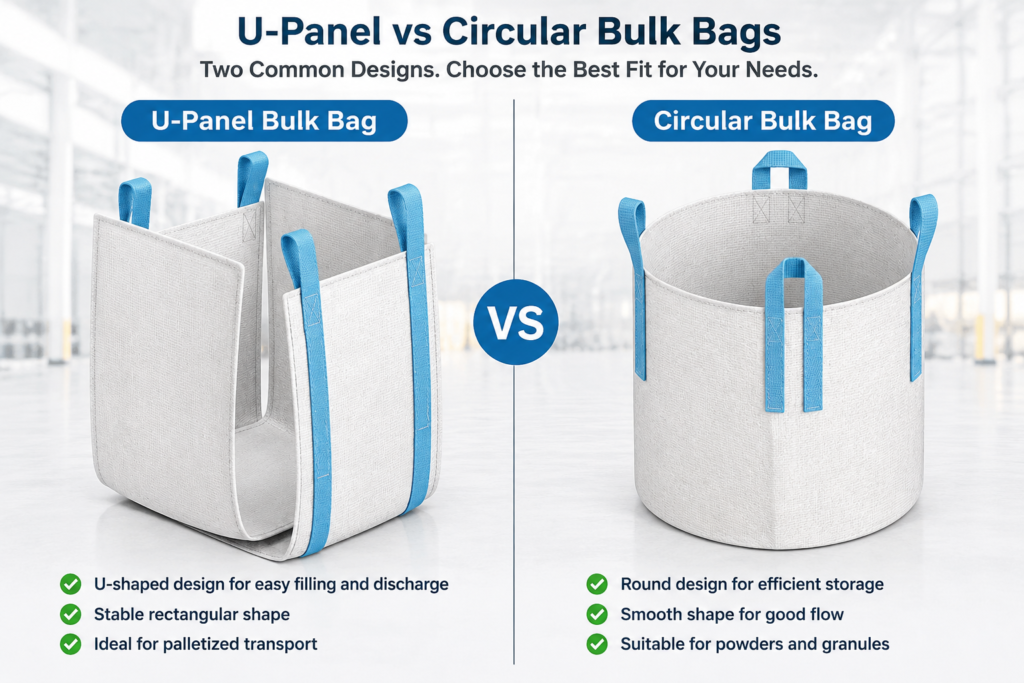
1. What Is a U-Panel Bulk Bag?
A U-panel bulk bag is made from three main fabric panels. One continuous piece of woven polypropylene (PP) fabric forms the bottom and two opposite sides of the bag, creating a U-shaped structure. Two additional panels complete the remaining sides.
This design provides a continuous fabric section across the bottom, making it a popular choice for general industrial and agricultural packaging.
Key Features of U-Panel FIBC Bags:
Durable woven polypropylene fabric construction.
Continuous U-shaped fabric section across the bottom and two sides.
Two main vertical side seams.
Versatile design for different bulk materials.
Customizable dimensions, lifting loops, and filling options.
U-panel bags are widely used for packaging fertilizers, minerals, grains, plastic resins, and other industrial materials.
Explore our U-Panel FIBC Bags to learn more about available designs, specifications, and customization options.
2. What Is a Circular Bulk Bag?
A circular bulk bag, also known as a tubular FIBC, is manufactured using polypropylene fabric woven on a circular loom.
The tubular fabric forms the main body of the bag without vertical side seams. Separate fabric panels are attached to complete the top and bottom.
This construction offers a practical solution for buyers who prefer a tubular bag design with fewer vertical seams along the body.
Key Features of Circular FIBC Bags:
Tubular woven polypropylene fabric construction.
No vertical body seams along the main tubular section.
Simple and practical bag structure.
Customizable top and bottom configurations.
Suitable for powders, granules, and various industrial materials.
Circular bulk bags can also be customized with different fabric weights, coatings, liners, and discharge options according to product requirements.
Discover our Circular FIBC Bags for more information about available specifications, designs, and customization options.
3. U-Panel vs Circular Bulk Bags: Key Differences
When comparing U-panel vs circular bulk bags, the main differences are their fabric construction, seam arrangement, and filled shape.
| Comparison | U-Panel Bulk Bags | Circular Bulk Bags |
|---|---|---|
| Main construction | Three fabric panels | Tubular woven fabric |
| Vertical body seams | Two main side seams | No vertical body seams |
| Bottom structure | Continuous U-shaped fabric section | Separate bottom panel |
| Filled shape | Generally rectangular, with possible bulging | Generally rounded, with possible bulging |
| Shape customization | Available | Available |
| Baffle option | Available | Available |
| Load capacity | Customized to requirements | Customized to requirements |
| Top and bottom options | Customizable | Customizable |
Both designs can be manufactured with different safe working loads (SWL), lifting loops, filling spouts, discharge spouts, and other accessories.
The actual performance depends on the complete bag design, material specifications, and manufacturing quality.
4. Strength and Load-Bearing Performance
Strength is an important factor when selecting an FIBC bulk bag.
U-panel bags feature a continuous fabric section that forms the bottom and two opposite sides. This construction provides a practical load-bearing structure for many industrial applications.
Circular bulk bags use tubular woven fabric to form the main body. They also offer reliable performance when manufactured with suitable fabric specifications, stitching, and lifting-loop designs.
However, neither construction is automatically stronger than the other.
Both U-panel and circular bulk bags can be customized to meet different load requirements. Their safe working load depends on fabric strength, fabric weight, bag dimensions, stitching, lifting-loop construction, and testing results.
Before ordering, buyers should confirm the required SWL and safety factor with their supplier.
5. Shape Retention: Can Both Designs Have Baffles?
Yes. One important advantage of our manufacturing capabilities is that both U-panel and circular bulk bags can be customized with internal baffles.
Baffles are additional fabric panels sewn inside the bag corners. They help control outward bulging and allow the filled bag to maintain a more square shape.
Compared with standard bulk bags, baffled FIBCs can provide:
Better shape retention after filling.
More efficient use of pallet space.
Improved storage and transportation arrangements.
Better dimensional consistency when handling bulk materials.
For buyers who need improved space utilization, both U-panel and circular constructions can be designed with baffles according to the required specifications.
This means you do not have to choose between U-panel and circular construction based only on whether baffles are available.
6. Which Bulk Bag Should You Choose?
The best option depends on your product characteristics, filling process, storage conditions, and transportation requirements.
Choose U-Panel Bulk Bags If:
You prefer a conventional panel-based bag construction.
You need a continuous fabric section across the bottom and two sides.
You want a versatile solution for industrial or agricultural products.
You require customized dimensions and load specifications.
Learn more about our U-Panel Bulk Bags and available customization options.
Choose Circular Bulk Bags If:
You prefer tubular woven PP fabric construction.
Reducing vertical body seams is important.
Your application is suitable for a tubular bag design.
You need customized filling, discharge, or liner options.
Explore our Circular Bulk Bags to find a suitable design for your packaging requirements.
Choose Baffled FIBC Bags If:
You want better shape retention after filling.
You need more efficient pallet and container space utilization.
You prefer a squarer filled bag shape.
Your storage and transportation requirements demand better dimensional control.
Both U-panel and circular bags can be manufactured with baffles to meet these requirements.
7. What Information Do You Need Before Ordering?
To help your supplier recommend the right FIBC design, prepare the following information:
Product type: Powder, granules, fertilizer, minerals, or other materials.
Bag dimensions: Required length, width, and height.
Safe working load: Required filling weight per bag.
Top design: Open top, duffle top, or filling spout.
Bottom design: Flat bottom or discharge spout.
Fabric requirements: Coated or uncoated PP woven fabric.
Additional options: Baffles, liners, printing, and other customization requirements.
Providing these details helps your supplier develop a suitable bulk bag solution for your application.
8. U-Panel vs Circular Bulk Bags: Final Recommendation
There is no single best choice for every application.
U-panel bulk bags offer a versatile panel-based construction with a continuous fabric section across the bottom and two sides. Circular bulk bags provide a tubular body design with fewer vertical body seams.
Both constructions can be customized with different dimensions, load capacities, filling and discharge options, and internal baffles.
When evaluating U-panel vs circular bulk bags, focus on your actual packaging requirements rather than choosing based on construction type alone.
At UWON Packaging, we provide customized FIBC bulk bags to meet different industrial packaging requirements. Whether you need U-panel or circular bulk bags, with or without internal baffles, our team can help you find a suitable solution.
Contact us today to discuss your bulk bag specifications and request a competitive quotation.
Frequently Asked Questions
1. What is the main difference between U-panel and circular bulk bags?
U-panel bags use one continuous U-shaped fabric panel and two additional side panels. Circular bags use tubular woven PP fabric to form the main body. Their main differences are construction and vertical seam arrangement.
2. Are U-panel bulk bags stronger than circular bulk bags?
Not necessarily. Both designs can be manufactured for different load requirements. Actual strength depends on fabric specifications, stitching, lifting-loop design, and testing.
3. Can circular bulk bags have baffles?
Yes. Circular bulk bags can be manufactured with internal baffles to improve shape retention and reduce outward bulging after filling.
4. Can U-panel bulk bags have baffles?
Yes. U-panel bulk bags can also be customized with internal baffles. This allows buyers to combine U-panel construction with improved shape retention.
5. What is the standard load capacity of FIBC bulk bags?
There is no single standard capacity for every design. SWL can be customized according to bag dimensions, fabric specifications, construction, and customer requirements.
6. Can U-panel and circular bulk bags be customized?
Yes. Both types can be customized with different sizes, SWL ratings, safety factors, lifting loops, top and bottom designs, liners, coatings, printing, and baffles.